
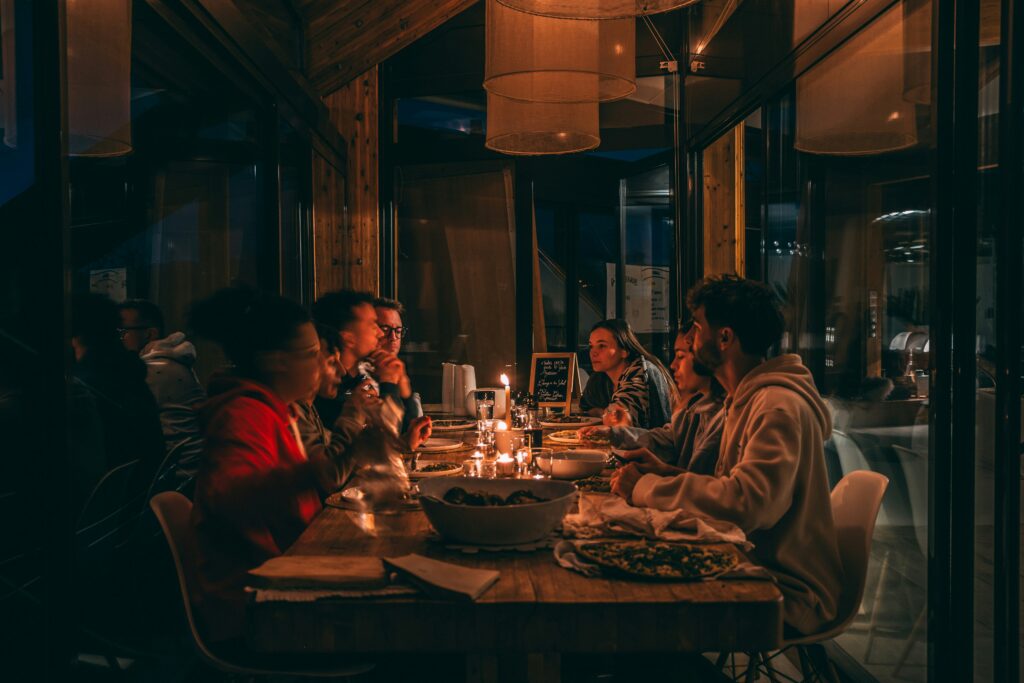
Sometimes the meal is the thing you came for. Other nights it’s one stop on the way through a bigger evening, and once it’s done it hands you off to whatever’s next. The food can be identical either way. What changes is the job it’s doing.
Worth thinking about, because a dish that works at a long slow table can feel wrong when you’re eating it between two other things.
The meal that is the whole evening
A supper club is the clearest case. You buy a ticket ahead, there’s one set menu, and you sit at a shared table with people you’ve never met. No ordering, no choosing. Everyone eats the same thing on the same night. And that night only happens once.
The format is built to slow you down. A lot of supper clubs open with a cocktail hour in a separate room before anyone sits. The old Wisconsin ones made a ritual of it, a brandy old fashioned first, then the table. Courses come spaced out on purpose. You’re there to linger, not to free up the seat.
So the kitchen is cooking for a room that isn’t going anywhere, and the food can take its time too. A long braise. A course that needs a minute of explaining before you eat it. A dessert nobody’s checking their watch over. Nothing on the plate competes for your attention. For the next few hours, the plate is the whole event.
The meal that fits around the show
Dinner theatre runs on different rules. The food arrives in the gaps in the performance. Act One, then the salad. Act Two, then the entrée. The courses are timed to the breaks. The kitchen’s rhythm matches that of the show.
The show’s timing shapes what’s on your plate. It has to land fast during a short scene change, and be easy to eat in a dim room with half your attention on the stage. Something that needs assembling at the table, or real concentration to eat, fights the show. The meal is working when you barely notice the handover from eating to watching and back.
It’s an old arrangement. Medieval banquet halls put minstrels and jesters on between courses. Dinner theatre just formalised the gaps.
The meal as one stop among several
Casino resorts treat dinner differently again. The meal is one room in a building full of them. You might eat before a show, or between other things, or because it’s the natural break in a longer night out. Few people come for the dinner on its own. They come for the evening, and dinner is a part of it.
That changes what the food is for. It’s a pause, a sit-down in the middle of a lot of moving around. The meal that works here is one you can enjoy without giving your whole night to the table, because the table isn’t where the night ends. You’re passing through.
Move the whole thing online and the question shifts. Take something like YYY Casino, where the entertainment lives on a screen. The dinner and the game no longer share a building. You’re eating at your own kitchen table, and the entertainment is somewhere else, on a phone, in another tab. The combined evening comes apart, and the meal goes back to being a meal, cooked and eaten at home, with the entertainment running alongside it instead of in the same room.
That’s the part worth holding onto. A resort dinner, a supper club, a plate between two acts, they feel like part of an evening because it’s all happening in one place, at one time, to the same people. Put the food in the kitchen and the show on a screen and you’ve still got dinner, and you’ve still got entertainment. They’re two things now, not one.
So what’s on the plate
The recipe barely comes into it. The same dish can suit one evening and misjudge another. What decides whether it works isn’t the cooking. It’s whether the food suits the night it’s turned up to.